
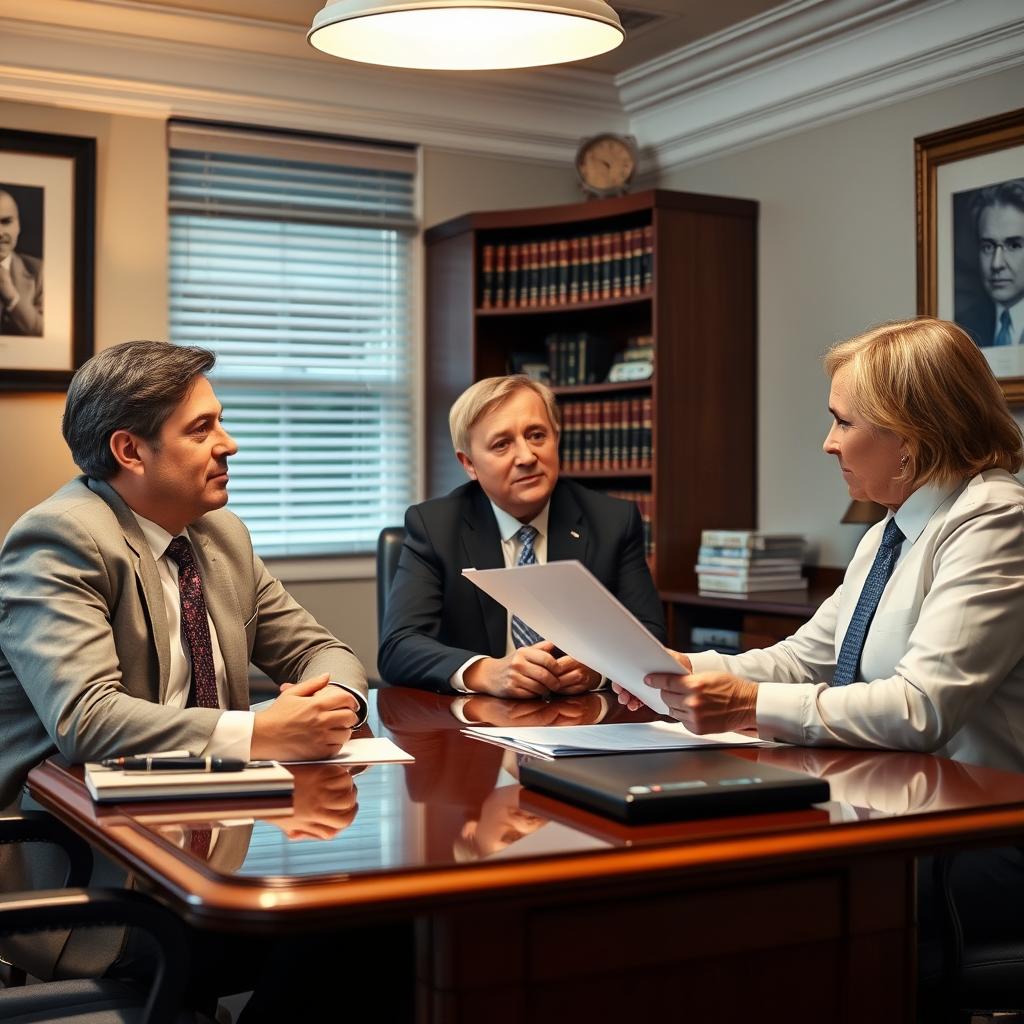
Estate Tax Planning Lawyer in Forest Hills, Washington, D.C.
An Estate Tax Planning Lawyer Forest Hills residents engage at Law Offices of SRIS, P.C. addresses two overlapping tax regimes: the federal estate tax (2026 exemption $15,000,000 per individual under 26 U.S.C. § 2010(c)) and the separate District of Columbia estate tax (2026 exemption approximately $4,988,400; rates 11.2%–16%; no spousal portability). Probate is administered through the D.C. Superior Court Probate Division at 515 5th Street NW, Washington, DC 20001.
Statutory Framework Governing DC Estate Tax Planning
Estate tax planning for Forest Hills residents draws on three principal bodies of law. First, the federal estate and gift tax regime under Subtitle B of the Internal Revenue Code, including the unified credit set out at 26 U.S.C. § 2010(c), which establishes a 2026 per-individual exemption of $15,000,000 following the federal legislative changes that took effect for 2026. Second, the District of Columbia estate tax, which is computed separately from federal tax, uses a 2026 exemption of approximately $4,988,400 per individual, applies graduated rates from 11.2% to 16%, and does not allow portability of the unused exemption between spouses. The DC exemption is not indexed identically to the federal exemption, so the gap between the two thresholds is significant and tends to widen.
Third, DC probate and trust administration are governed by D.C. Code Title 19 (trusts and estates) and D.C. Code Title 20 (administration of decedents’ estates), which together set out intestacy distributions, probate procedure, the powers and duties of personal representatives, and the rules for trust creation, modification, and termination. Intestacy under D.C. Code § 19-501 et seq. controls when a decedent dies without a valid will, distributing property to a defined statutory hierarchy of relatives. Advance medical directives in the District are governed by D.C. Code § 21-2207, which requires two adult witnesses, neither of whom may be the appointed agent, the healthcare provider, or an employee of the provider, and at least one of whom must not be related by blood, marriage, or adoption and must not be entitled to inherit; notarization is not required.
D.C. Superior Court Probate Division — Filing and Administration
Estate matters originating in Forest Hills are filed in the D.C. Superior Court Probate Division at 515 5th Street NW, Building A, 3rd Floor, Washington, DC 20001; the Probate Division main line is (202) 879-9460. The Probate Division is distinct from the Moultrie Courthouse at 500 Indiana Avenue NW, which houses other Superior Court divisions; will lodgments, petitions for probate, and accountings for estates and trusts are processed at the 5th Street location. From the firm’s Arlington location at 1655 Fort Myer Drive, Suite 700, Arlington, VA 22209, the Probate Division is approximately 4.7 miles away.
The standard DC probate timeline runs roughly 12 to 18 months for unsupervised administration, with small-estate procedures available for estates valued under $40,000. Will contests and fiduciary disputes can extend the timeline to 24 months or longer. Filing fees vary by estate value, and personal representative commissions follow DC statute. The Probate Division publishes its forms, fee schedule, and standing orders at dccourts.gov, which interested parties should consult for current filing requirements rather than relying on third-party summaries. Trust and estate provisions are at code.dccouncil.gov, Title 19, and procedural information appears at dccourts.gov.
Substantive Estate Tax Planning Tools for Forest Hills Residents
Estate tax planning for Forest Hills households generally combines lifetime transfer strategies, trust structures, and coordinated beneficiary designations. The starting point is an accurate valuation of the gross estate, which under federal rules includes real property, financial accounts, retirement assets, life insurance owned by the decedent, business interests, and certain transfers made within three years of death. Forest Hills homes have appreciated substantially over the last two decades, and a residence purchased for a modest sum in the 1990s can today represent a meaningful fraction of the DC exemption by itself. Understanding the gross estate is the foundation of any planning conversation.
For married couples, a credit-shelter or bypass trust is one of the most useful tools when DC residency is involved, because DC does not permit portability of the unused estate tax exemption between spouses. Without a credit-shelter structure, the estate of the first spouse to die may pass entirely to the survivor under the unlimited marital deduction, leaving the survivor with a doubled estate and only one DC exemption available at the second death. A properly drafted and funded credit-shelter trust captures the first spouse’s DC exemption at the first death so that it is not lost. The trust can be drafted to provide income and limited principal access to the surviving spouse during life while keeping the trust assets outside the survivor’s taxable estate.
Irrevocable life insurance trusts (ILITs) are another commonly used tool. Life insurance proceeds are includible in the decedent’s gross estate if the decedent held any incidents of ownership at death. By transferring an existing policy or having the trustee acquire a new policy, families can keep substantial death benefits outside the taxable estate while preserving liquidity to pay estate taxes, equalize inheritances among children, or fund a closely held business buyout. The three-year lookback rule under federal law applies to transfers of existing policies, which is why early planning matters.
Lifetime gifting using the federal annual exclusion (adjusted for inflation each year) is a foundational technique that operates independently of the lifetime exemption. Annual exclusion gifts do not consume the federal lifetime exemption and accumulate meaningful tax savings over time, particularly when made to a class of children and grandchildren. Section 529 education savings plan contributions allow front-loading of up to five years of annual exclusion gifts. Direct payments of tuition and medical expenses to providers do not count against the annual exclusion or lifetime exemption at all.
More advanced structures — grantor retained annuity trusts (GRATs), qualified personal residence trusts (QPRTs), charitable remainder trusts and charitable lead trusts, and family limited partnerships — are appropriate for higher-value estates and for families with closely held business interests. Each carries trade-offs in administrative complexity, loss of control, and interaction with grantor-trust income tax rules. The choice among structures depends on the family’s cash-flow needs, charitable intent, business succession goals, and tolerance for irrevocability. Beneficiary designations on retirement accounts and life insurance must be coordinated with the overall plan, because those assets pass outside the will and can override carefully drafted testamentary structures if neglected. The SECURE Act 2.0 changes to required minimum distribution rules and the ten-year payout rule for non-eligible designated beneficiaries have meaningfully altered the calculus for naming trusts as IRA beneficiaries.
DC and Federal Estate Tax Exposure — Snapshot
For 2026, Forest Hills residents face a $4,988,400 DC exemption and a $15,000,000 federal exemption per individual, with DC rates of 11.2% to 16% and federal rates up to 40%.
| Item | 2026 Threshold / Rate | Authority |
|---|---|---|
| Federal estate tax exemption (per individual) | $15,000,000 | 26 U.S.C. § 2010(c) |
| Federal top marginal estate tax rate | 40% | Internal Revenue Code Subtitle B |
| DC estate tax exemption (per individual) | ~$4,988,400 | DC Office of Tax and Revenue 2026 schedule |
| DC estate tax rate band | 11.2% – 16% | DC Office of Tax and Revenue 2026 schedule |
| DC spousal portability of exemption | Not allowed | DC statute (no portability provision) |
| Federal annual gift exclusion (per donee, 2026) | Inflation-indexed | 26 U.S.C. § 2503(b) |
| Federal tax evasion (willful) | Up to five years imprisonment; fines up to $100,000 (individual) or $500,000 (corporation) | 26 U.S.C. § 7201 |
Results may vary. Tax thresholds are adjusted periodically; figures above reflect 2026 information available as of the page date. Planning should be reviewed when tax law changes, when family circumstances change, and when asset values cross relevant thresholds.
About Mr. Sris
Mr. Sris is the founder and Mr. Sris of SRIS, P.C., which he founded in 1997. Mr. Sris is a former prosecutor and is admitted in Virginia, Maryland, District of Columbia, New Jersey, and New York. His practice includes complex civil and criminal matters; on trust and estate matters he works with clients on planning, administration, and dispute resolution. His background in accounting and information systems supports a detail-oriented approach to estate tax planning, where valuation, lifetime transfer history, and basis tracking matter as much as the testamentary documents themselves. Mr. Sris testified before the Virginia House Courts of Justice Committee in support of 2019 HB 635 (chief patron Del. David Bulova), the bill that became the 2019 revision to Va. Code § 20-107.3(g); the bill history is available at lis.virginia.gov. The firm brings 4,739+ documented results across VA, MD, DC, NJ and NY. Results may vary.
Case Results — Not Currently Published
Specific case outcomes for trust and estate matters in Forest Hills, DC are not currently published. Contact the firm directly at (888) 437-7747 for case-specific information. Past results do not guarantee a similar outcome. Results may vary.
Contact, Service Area, and Consultation Information
Forest Hills clients are served from the firm’s Arlington location at 1655 Fort Myer Drive, Suite 700, Room 719, Arlington, VA 22209, approximately 4.7 miles from the D.C. Superior Court Probate Division. The local line for Arlington is (703) 589-9250, and the firm’s toll-free number is (888) 437-7747. The Arlington location accepts in-person consultations by appointment only. Customer care available 24/7/365. Attorney consultations by appointment. Mr. Sris is the lead attorney for District of Columbia trust and estate matters under the firm’s jurisdictional mapping. The firm serves Forest Hills and the surrounding neighborhoods including Van Ness, Cleveland Park, Chevy Chase DC, Spring Valley, Tenleytown, Friendship Heights, and Woodley Park. Advocacy Without Borders.
Frequently Asked Questions — Estate Tax Planning Lawyer Forest Hills
Does the District of Columbia impose its own estate tax separate from the federal estate tax?
Yes. The District of Columbia imposes a separate estate tax with a 2026 exemption of approximately $4,988,400 per individual and graduated rates of 11.2% to 16%. DC does not allow portability of the unused exemption between spouses, which means that a married couple who relies solely on the unlimited marital deduction without additional planning can lose the first spouse’s DC exemption permanently. A credit-shelter or bypass trust structure is one of the principal tools to preserve both exemptions.
How does the federal estate tax exemption interact with the DC estate tax for a Forest Hills resident?
For 2026 the federal exemption is $15,000,000 per individual under 26 U.S.C. § 2010(c) as adjusted by recent federal legislation, while the DC exemption sits at approximately $4,988,400. A Forest Hills resident with a taxable estate between those two thresholds may owe no federal estate tax but still owe DC estate tax on the excess above the DC threshold. Coordinated planning addresses both regimes; ignoring DC in reliance on the federal number alone is a common and expensive oversight.
What planning tools can reduce DC estate tax exposure for Forest Hills families?
Tools include lifetime gifting that uses the federal annual exclusion, irrevocable life insurance trusts to remove insurance proceeds
Case results depend on a variety of factors unique to each case.
Attorney advertising. Prior results do not guarantee a similar outcome.